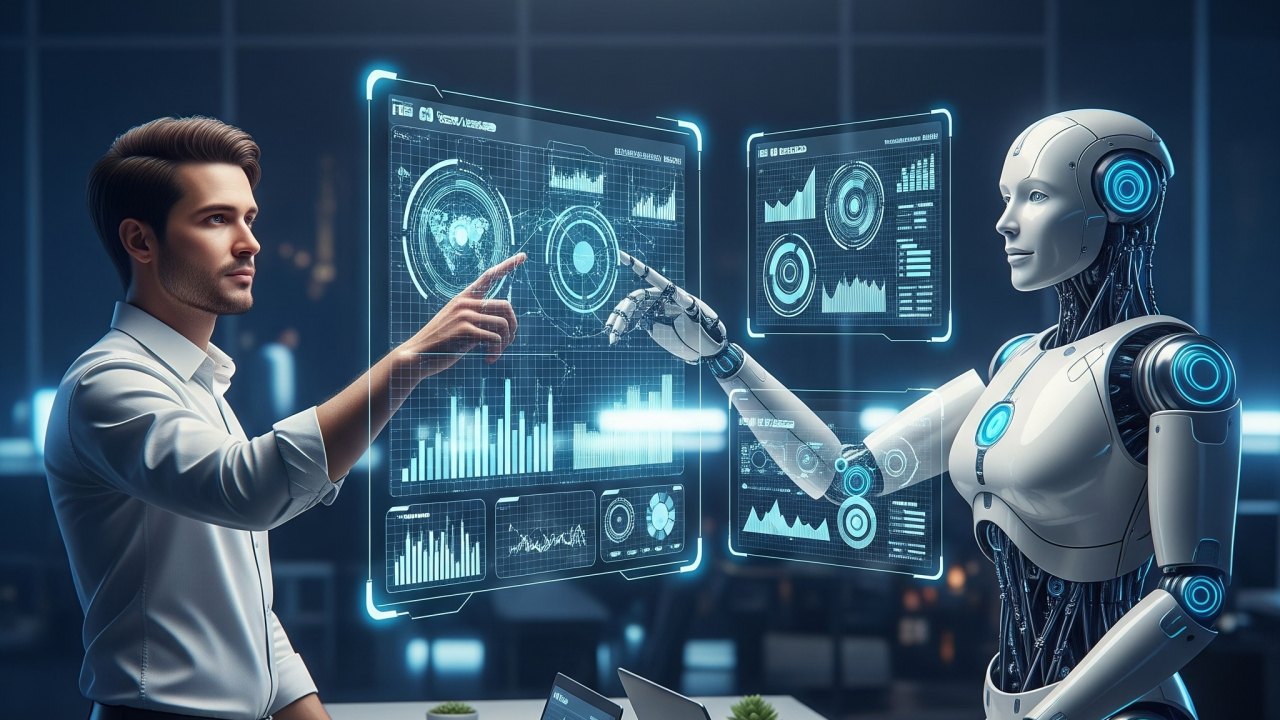
Artificial intelligence is no longer a futuristic fantasy; it is the silent engine driving much of our digital lives. From recommending your next favorite show to drafting emails, AI’s tendrils reach into nearly every corner of modern existence. But as we stand in 2026, we are moving past the initial hype. The conversation has shifted from “What can AI do?” to “What should AI do, and how can we use it without losing what makes us human?”
This isn’t just a technological evolution; it’s a philosophical one that is reshaping industries like marketing, architecture, and healthcare, forcing us to redefine creativity, efficiency, and trust.
The Great Enabler: Revolutionizing How We Work
One of the most profound impacts of AI today is its ability to automate the mundane, freeing human talent for higher-level thinking. In the world of Search Engine Optimization (SEO) and content creation, AI has evolved from a simple idea generator to a crucial team member . It automates technical audits, flags thousands of broken links, detects metadata issues, and drafts initial content structures .
However, the smartest teams use AI as a starting point, not a finish line. The focus has moved from simply “scaling” generic content to creating “information gain.” Search engines are now sophisticated enough to filter out derivative, low-quality AI content . For a brand to be cited as a source of truth by AI search tools like ChatGPT or Google’s AI Mode, they must offer original research and lived experience—things a machine cannot invent . It marks a shift from SEO (optimizing for people) to AIO (Artificial Intelligence Optimization), where content must be fact-dense, well-structured, and human-led to earn “citations” from AI agents .
The creative industries are also experiencing a profound transformation. Consider architecture. A recent experiment by a Chinese architect highlighted that AI is extraordinary at execution, but it cannot initiate the “spark” of inspiration . While AI can handle the complex, error-prone technical drawings and logistics, the initial concept—the idea that connects unrelated things in a new way—remains exclusively human .
The Human Core: Trust and Authenticity
If AI is so efficient, what is the role of the human? The answer increasingly lies in values we are only now beginning to fully appreciate.
Empathy and comprehensibility. In a fascinating study on digital health communication, participants actually rated AI-generated responses as more empathetic and easier to understand than those written by human physiotherapists . This suggests that AI can be a powerful tool for clear, supportive information delivery. Yet, researchers caution this must not be mistaken for clinical validity .
Creativity and the “Soul.” In architecture, music, and literature, creators are drawing a firm line. A renowned science fiction writer, for example, stated she uses AI for research but refuses to let it write her stories. “For me, creation is joy—even a painful one—so I don’t want anyone else to play the game for me,” she said, fearing that ceding the writing to AI would reduce the creator to a mere spectator .
Responsibility and Accountability. As Turing Award laureate Joseph Sifakis recently pointed out, just because AI can pass a medical exam doesn’t mean it should practice medicine . AI lacks the situational awareness, responsibility, and creative reasoning required for human-level accountability. We are naturally drawn to human-like AI, but we cannot mistake resemblance for responsibility .
The Future: Coexistence and Co-creation
The future is not a battle between human and machine. It is a partnership. We are moving toward a world where we must treat AI as an extension of our own capabilities—and perhaps, even recognize intelligence beyond ourselves. Scholars are beginning to argue for a more inclusive ontology of intelligence, moving beyond the Western-centric, Cartesian view that sees intelligence as a purely computational phenomenon .
AI could act as an “interface” through which different forms of intelligence—human, animal, and even ecological—can be brought into relation to tackle complex challenges like climate change . This means designing AI not just for power and profit, but for coexistence and collective well-being .
Moreover, technology is now allowing us to inject personality back into AI. The “PsychAdapter,” a tool developed by Stanford and Vanderbilt researchers, can generate text that reflects specific psychological profiles. This isn’t just about making AI more human-like; it has practical applications, such as training crisis counselors with simulated patients or personalizing educational materials .
Practical Steps: Your “Humanity-First AI” Checklist
If you are looking to integrate AI into your personal or professional life without losing sight of your humanity, consider these actionable steps:
- Be the Editor, Not the Author (or Just the Presser of Buttons): When using AI to write, treat the output as a rough draft from an eager intern. Review every fact, check the sources, and infuse it with your unique voice and anecdotes. Your lived experience is what makes it valuable. As Adam Kiezun notes in his “AI editorial crew” experiment, he acts as the human editor-in-chief, approving topics and final drafts, and crucially, fixing the AI’s feedback loop to improve future output .
- Structure Content for “Agentic” Consumption: The way we write is changing. To be cited by AI search bots, structure content using clear, descriptive headings formatted as questions, followed by concise, factual paragraphs (about 300-500 tokens). Implement advanced schema (like FAQ and HowTo markup) to “hand-feed” information to AI agents, ensuring they can easily extract your expertise .
- Focus on “Information Gain”: Avoid using AI to flood your channels with generic blog posts. Instead, use AI for technical grunt work—like analyzing keyword gaps or auditing your site’s speed—and invest your human time in creating unique research, data studies, and thought leadership that AI cannot replicate .
- Audit Your AI’s “Personality”: If you are using AI for customer service or critical communications, remember that its “default” voice is a generic, neutral tone. Consider whether you need to “train” it using your company’s style guides or even explore psychology-based tools to tailor the language to different customer personas .
Conclusion
The headline of our AI story is no longer about the sheer power of the machine. It is a story about partnership. The most successful individuals and companies in the coming years will not be those who replace humans with AI, but those who master the art of integrating it. They will use AI to handle the mundane and amplify the technical, while doubling down on the human skills that matter most: creativity, empathy, strategic thinking, and accountability.
AI is the tool. Humanity is the architect.
